Pinball

The Latest

Recent Stories

How Much Room Do You Need for a Pinball Machine at Home?

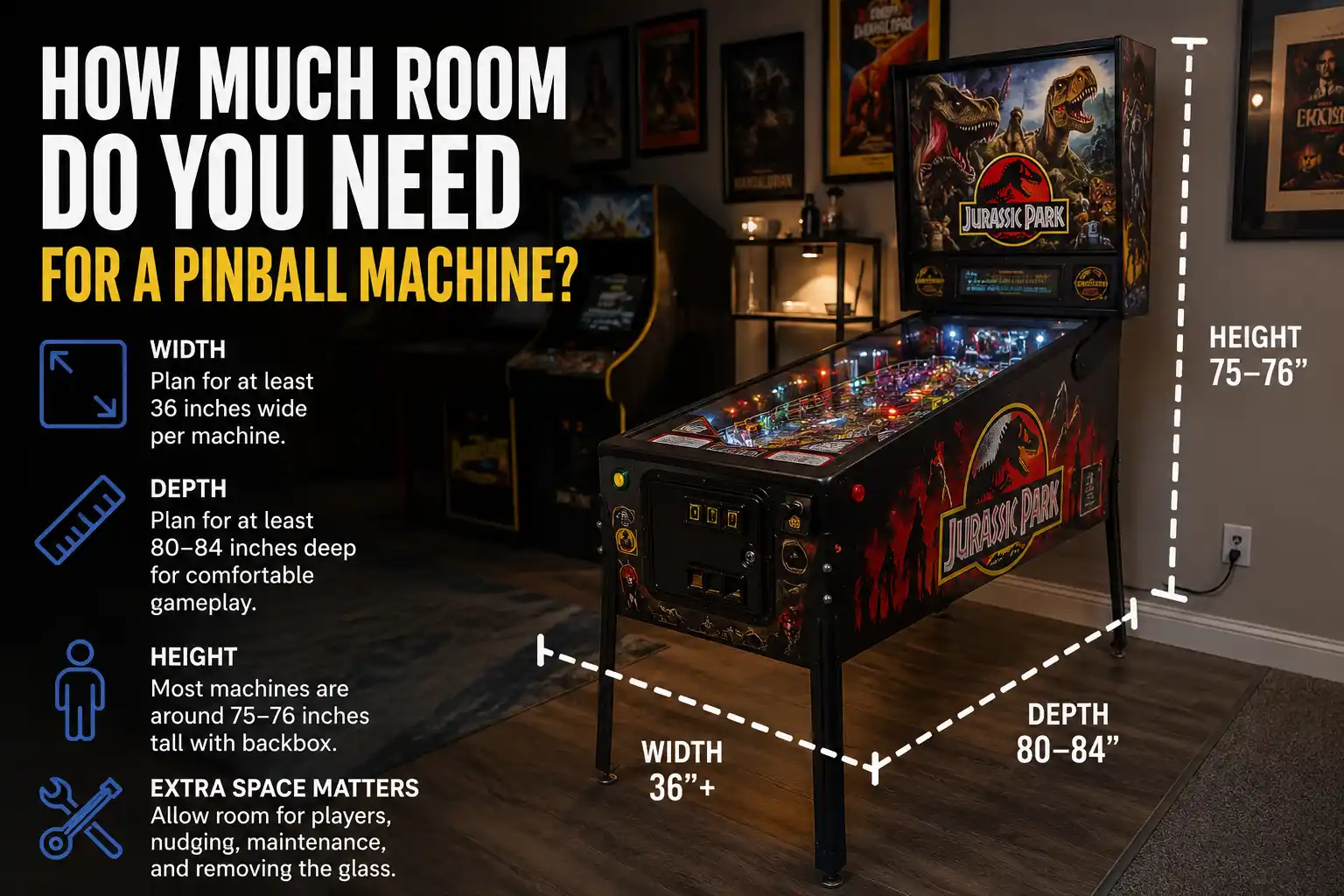
TLDR The short answer is that a real pinball machine does not need a massive room, but it does need more space than its cabinet dimensions suggest. If you are asking how much room do you need for a pinball machine, the safe home answer is simple: plan for about 3 feet of width and 7 feet of depth per machine. That gives the game enough room to sit, enough room for the player to stand naturally, and enough clearance for the machine to be serviced without turning every minor adjustment into a furniture-moving project. Why The Cabinet Measurement Is Not Enough A pinball machine looks narrow from the front. That is the trap. Most modern full-size machines are only a little over two feet wide. On paper, that sounds easy. You might look at a basement wall, office corner, spare bedroom, garage, or theater room and think, “That will fit.” Maybe it will. But pinball is not like sliding a bookcase into a corner. A machine has to be played, nudged, opened, leveled, cleaned, repaired, and occasionally moved. It has a backbox. It has a lockdown bar. It has legs that need space. It has a glass sheet that slides out the front. It has a coin door, buttons, side rails, power cord, and sometimes wall-sensitive topper or backbox clearance. The machine’s listed dimensions tell you whether the object fits. They do not tell you whether the room works. That is the difference this guide is really about. The Practical Home Footprint For One Pinball Machine For one full-size pinball machine, use this planning rule: Minimum workable space: 36 inches wide by 80 inches deep Comfortable space: 42 inches wide by 84 inches deep Ideal space: 48 inches wide by 90 inches deep The machine itself may only be around 27 to 29 inches wide, but giving it at least 36 inches of width makes the room easier to use. That extra side clearance helps with nudging, cleaning, leveling, and avoiding scratches against walls or other machines. Depth is even more important. A typical machine cabinet may be around 55 inches deep, but the player needs space behind the lockdown bar. If the game is crammed into a 60-inch-deep nook, technically it may fit, but nobody will enjoy playing it. A realistic setup needs space for: That is why about 7 feet of room depth is the number that keeps coming up in real home setups. How Much Room Do You Need For A Pinball Machine If It Is Against A Wall? If the machine is going against a wall, plan for a little breathing room behind it. You do not need a giant gap. Pinball machines are designed to sit near walls in arcades and game rooms. But you also do not want the backbox jammed hard against drywall, trim, curtains, shelves, or acoustic panels. A good home setup leaves enough space to: For most home rooms, leaving 2 to 4 inches behind the machine is enough. If you have a topper, wall shelf, low ceiling, mounted TV, framed poster, or slanted ceiling, measure more carefully. The danger is not usually the machine body. The danger is the upper area around the backbox, topper, ceiling, and wall décor. Do You Need Side Clearance? Yes, but not always as much as people think. A single machine can sit fairly close to a wall on one side. Many home owners do that. But if you are choosing the best spot in the room, leave a few inches of side clearance when possible. Side clearance helps with: If you only have one machine, try to leave 3 to 6 inches on each side if the room allows it. If you are placing machines side by side, the spacing can be tighter. In a dedicated pinball row, machines often sit close together. Still, leaving a little space between cabinets makes the row easier to live with. It also reduces the chance of side art damage when someone moves, cleans, or services a game. How Much Space Do You Need For Two Pinball Machines? For two full-size pinball machines side by side, the absolute machine width may be only about 54 to 58 inches total. But a comfortable home row needs more than that. Use this rule: Tight two-machine setup: about 5.5 feet wide Comfortable two-machine setup: about 6 to 6.5 feet wide Ideal two-machine setup: 7 feet wide or more The wider number gives you breathing room between machines and side clearance at the ends. It also makes the row look intentional instead of wedged into a leftover wall. Depth stays about the same as one machine. You still want roughly 7 feet of usable depth from the wall to the standing area. A two-machine row works especially well in: It works less well in narrow rooms where the player blocks the entire walkway. A pinball machine can technically fit in a hallway-style room, but if every game forces people to squeeze past the player, the room will feel annoying fast. How Much Space Do You Need For Three Or More Pinball Machines? Once you get to three machines, think in terms of a real row. For three full-size machines, plan for at least 9 feet of wall width if you want the setup to feel comfortable. You may be able to do it tighter, but 9 feet gives you a much better result. For four machines, plan for roughly 12 feet or more. For five machines, plan for roughly 15 feet or more. These are not hard engineering numbers. They are practical room-planning numbers. They assume a full-size game, some side clearance, and a room that still feels usable. The bigger issue becomes the player zone. Three people can stand at three machines at once. Four people can gather behind them. Suddenly your “pinball wall” is not just furniture. It is a social area. That means you should also think about: A single pinball machine is a piece of entertainment

What Pinball Machine Should You Rent First If You Like Godzilla’s Deep Code?

TLDR The best first pinball rental for someone who likes Godzilla’s deep code is usually Jaws Premium. It has meaningful progression, clear goals, strong modern Stern design, and enough depth to test whether you want a long-term home game without jumping straight into the most punishing options. Why Godzilla Creates A Very Specific Problem Some pinball machines are fun for ten games. Others make you feel like you are slowly learning a world. That is what Godzilla does well. Players who connect with it often are not just responding to the theme, the toys, or the shots. They are responding to the feeling that almost everything matters. A shot might help with a city objective, kaiju battle, multiball, ally, destruction bonus, or late-game progress. Even when a ball does not become a monster score, it usually feels like something moved forward. That creates a tricky rental question: what pinball machine should you rent first if you want that same deep, useful-shot feeling, but you do not want to bring home something that frustrates everyone else in the house? The answer is not simply “rent the highest-rated game available.” Some great machines are demanding. Some deep machines are hard to explain. Some approachable machines are fun but smaller in scope. The right first rental should test three things at once: For that specific test, Jaws Premium is the best starting point. The Main Thing To Look For: Useful-Shot Density The long-tail question is not really “what is the best pinball machine?” It is more specific: What machine feels like Godzilla, where almost every shot seems to build progress? A useful way to think about that is useful-shot density. A game has high useful-shot density when ordinary shots keep feeding bigger systems. You are not just collecting points. You are moving toward modes, multiballs, perks, equipment, rescues, battles, wizard modes, or long-term objectives. A low useful-shot-density game can still be fun. It might be fast, funny, brutal, simple, or satisfying in short bursts. But if you are chasing the Godzilla feeling, you want more than a single mode ladder. You want parallel progress. That is why the best first rentals are not always the deepest games on paper. They are the games where depth, clarity, and shot friendliness meet. Best First Rental: Jaws Premium Jaws Premium is the best first rental if you want a modern machine that feels substantial without becoming homework. The appeal is easy to understand. You are hunting the shark, saving beachgoers, collecting gear, building toward bigger moments, and working through a structure that makes sense even if someone has not studied a rulesheet. That matters for a rental. You do not want to spend the first two days explaining why the game is fun. The machine needs to make a case for itself while people are actually playing it. Jaws also gives you a strong read on what kind of home pinball player you are. If your household enjoys Jaws, you probably like modern Stern depth, cinematic goals, and a game that asks for skill without feeling totally closed off. If your household finds it too fast or too aggressive, that tells you something useful before you spend purchase-level money. The tradeoff is that Jaws can feel sharper than Godzilla. It is not the softest, friendliest modern Stern. Some shots carry real risk. The scoring can come in large chunks, and better players will separate themselves quickly. But as a first rental, that is not a deal-breaker. It is actually helpful. You are testing the upper edge of what your household enjoys. If Jaws feels exciting rather than exhausting, it belongs on the serious buy list. Rent Jaws First If Be Careful If Best Campaign-Style Rental: Dungeons & Dragons: The Tyrant’s Eye If Jaws is the best first all-around test, Dungeons & Dragons: The Tyrant’s Eye is the best test for a long-form owner game. This is the machine to rent if you are drawn to character selection, classes, saved progress, equipment, inventory, choices, dungeon structure, and the sense that the game can keep unfolding over many plays. It is not just “start a mode, finish a mode, start another mode.” It is trying to make pinball feel like an ongoing campaign. That makes it very interesting for a home environment. A game like this can reward repeated play in a different way than a simpler shooter. You can keep learning how its systems connect. You can build familiarity with classes and strategies. You can start thinking beyond “what shot is lit?” and into “what kind of run am I building?” The concern is not mainly that the shots are brutally unfair. The bigger issue is mental load. Some players will love the structure. Others may feel like the game is asking them to understand too much before they can fully enjoy it. That is why it is a smart rental. You do not need to guess. Put it in the house for a month and watch what happens. Do people come back because the campaign hooks them, or do they wander back to simpler machines? Rent Dungeons & Dragons First If Be Careful If Best If You Can Find One: Batman ’66 Batman ’66 belongs in this conversation because it has real home-game depth without feeling as punishing as some modern machines. The problem is availability. It is an older Stern title, and finding a clean one to rent or buy can be harder than finding current-production games. But if a local rental company has one, it is absolutely worth testing. The structure gives players a lot to chew on. Major villains, minor villains, gadgets, mode progress, playfield features, and long-term objectives keep the game feeling large. It has that “there is always something else moving” quality that Godzilla fans often want. It also has a different rhythm. Batman ’66 can feel more deliberate and stop-start than Godzilla. That is not automatically bad. For a home game, a slightly more deliberate machine can be easier

Social Media

New From Game-Revolution

Get The Latest Updates

Subscribe To Our Weekly Newsletter

No spam, notifications only about new products, updates.

Categories

Trending

Most Popular Stories