TLDR
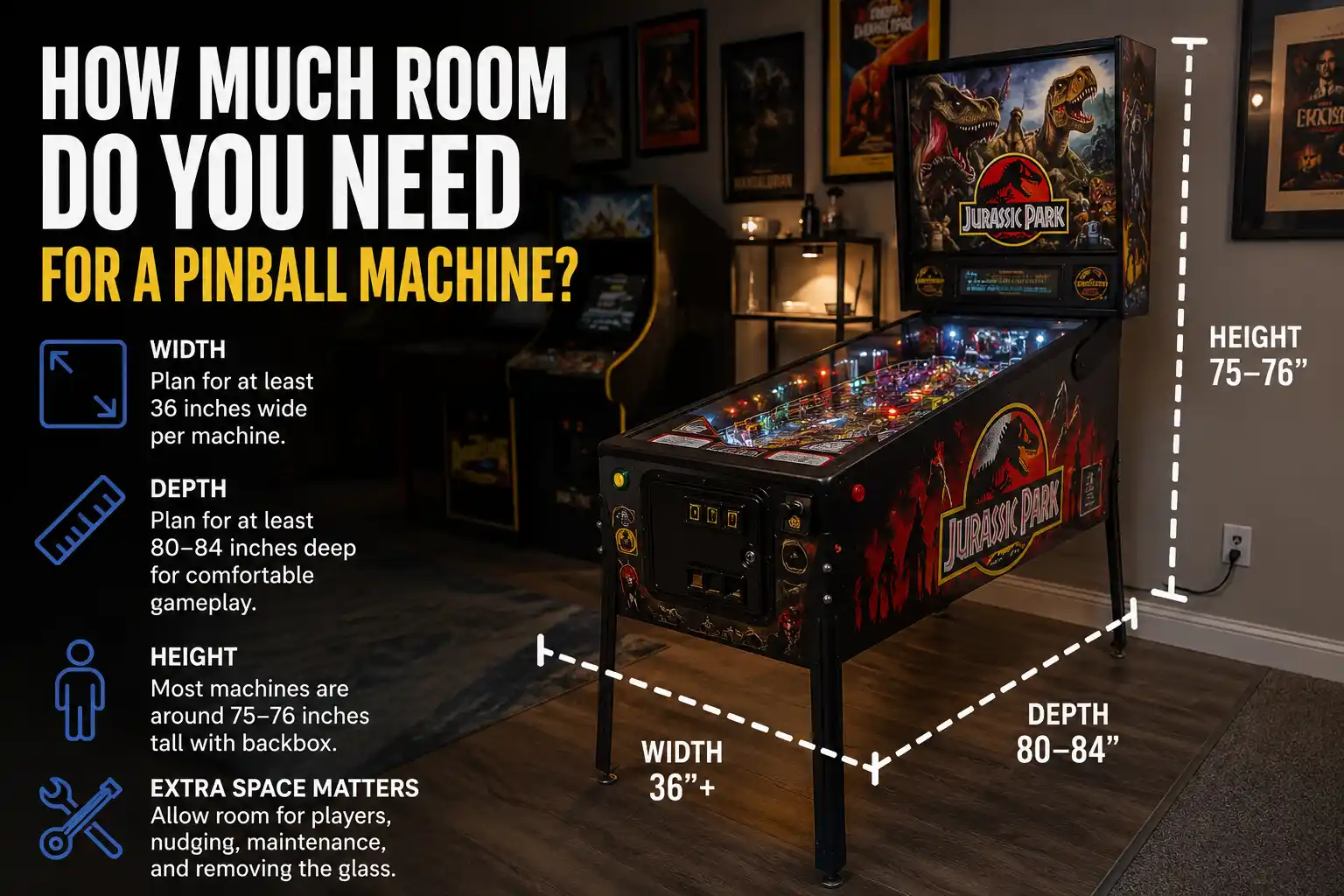
- A full-size pinball machine usually needs about 3 feet wide by 7 feet deep of usable room to feel comfortable.
- The machine itself is usually around 27 to 29 inches wide, 55 inches deep, and 75 to 76 inches tall when set up.
- The extra space matters more than the cabinet size. You need room for the player, nudging, glass removal, service access, and people walking behind the game.
- For one machine, plan on a practical footprint of 36 inches wide by 80 to 84 inches deep.
- For two machines side by side, plan on at least 6 feet of wall width, and more if you want the row to feel comfortable.
- Measure doorways, stair turns, ceiling height, and the final play area before buying or renting.
The short answer is that a real pinball machine does not need a massive room, but it does need more space than its cabinet dimensions suggest. If you are asking how much room do you need for a pinball machine, the safe home answer is simple: plan for about 3 feet of width and 7 feet of depth per machine.
That gives the game enough room to sit, enough room for the player to stand naturally, and enough clearance for the machine to be serviced without turning every minor adjustment into a furniture-moving project.
Why The Cabinet Measurement Is Not Enough
A pinball machine looks narrow from the front. That is the trap.
Most modern full-size machines are only a little over two feet wide. On paper, that sounds easy. You might look at a basement wall, office corner, spare bedroom, garage, or theater room and think, “That will fit.”
Maybe it will.
But pinball is not like sliding a bookcase into a corner. A machine has to be played, nudged, opened, leveled, cleaned, repaired, and occasionally moved. It has a backbox. It has a lockdown bar. It has legs that need space. It has a glass sheet that slides out the front. It has a coin door, buttons, side rails, power cord, and sometimes wall-sensitive topper or backbox clearance.
The machine’s listed dimensions tell you whether the object fits.
They do not tell you whether the room works.
That is the difference this guide is really about.
The Practical Home Footprint For One Pinball Machine
For one full-size pinball machine, use this planning rule:
Minimum workable space: 36 inches wide by 80 inches deep
Comfortable space: 42 inches wide by 84 inches deep
Ideal space: 48 inches wide by 90 inches deep
The machine itself may only be around 27 to 29 inches wide, but giving it at least 36 inches of width makes the room easier to use. That extra side clearance helps with nudging, cleaning, leveling, and avoiding scratches against walls or other machines.
Depth is even more important. A typical machine cabinet may be around 55 inches deep, but the player needs space behind the lockdown bar. If the game is crammed into a 60-inch-deep nook, technically it may fit, but nobody will enjoy playing it.
A realistic setup needs space for:
- the full cabinet depth
- the player’s stance
- small body movement while playing
- people passing behind the player
- opening the coin door
- sliding out the playfield glass
- pulling the machine forward when needed
That is why about 7 feet of room depth is the number that keeps coming up in real home setups.
How Much Room Do You Need For A Pinball Machine If It Is Against A Wall?
If the machine is going against a wall, plan for a little breathing room behind it.
You do not need a giant gap. Pinball machines are designed to sit near walls in arcades and game rooms. But you also do not want the backbox jammed hard against drywall, trim, curtains, shelves, or acoustic panels.
A good home setup leaves enough space to:
- avoid scraping the wall
- route the power cord safely
- reduce backbox vibration against the wall
- allow tiny leveling adjustments
- pull the machine forward if something needs attention
For most home rooms, leaving 2 to 4 inches behind the machine is enough. If you have a topper, wall shelf, low ceiling, mounted TV, framed poster, or slanted ceiling, measure more carefully.
The danger is not usually the machine body. The danger is the upper area around the backbox, topper, ceiling, and wall décor.
Do You Need Side Clearance?
Yes, but not always as much as people think.
A single machine can sit fairly close to a wall on one side. Many home owners do that. But if you are choosing the best spot in the room, leave a few inches of side clearance when possible.
Side clearance helps with:
- nudging the machine without hitting a wall
- opening the coin door comfortably
- adjusting leg levelers
- cleaning around the machine
- protecting side art from scuffs
- making the setup feel less cramped
If you only have one machine, try to leave 3 to 6 inches on each side if the room allows it.
If you are placing machines side by side, the spacing can be tighter. In a dedicated pinball row, machines often sit close together. Still, leaving a little space between cabinets makes the row easier to live with. It also reduces the chance of side art damage when someone moves, cleans, or services a game.
How Much Space Do You Need For Two Pinball Machines?
For two full-size pinball machines side by side, the absolute machine width may be only about 54 to 58 inches total. But a comfortable home row needs more than that.
Use this rule:
Tight two-machine setup: about 5.5 feet wide
Comfortable two-machine setup: about 6 to 6.5 feet wide
Ideal two-machine setup: 7 feet wide or more
The wider number gives you breathing room between machines and side clearance at the ends. It also makes the row look intentional instead of wedged into a leftover wall.
Depth stays about the same as one machine. You still want roughly 7 feet of usable depth from the wall to the standing area.
A two-machine row works especially well in:
- basements
- bonus rooms
- garages
- theater rooms
- office lounges
- wide hall-style recreation rooms
It works less well in narrow rooms where the player blocks the entire walkway. A pinball machine can technically fit in a hallway-style room, but if every game forces people to squeeze past the player, the room will feel annoying fast.
How Much Space Do You Need For Three Or More Pinball Machines?
Once you get to three machines, think in terms of a real row.
For three full-size machines, plan for at least 9 feet of wall width if you want the setup to feel comfortable. You may be able to do it tighter, but 9 feet gives you a much better result.
For four machines, plan for roughly 12 feet or more.
For five machines, plan for roughly 15 feet or more.
These are not hard engineering numbers. They are practical room-planning numbers. They assume a full-size game, some side clearance, and a room that still feels usable.
The bigger issue becomes the player zone. Three people can stand at three machines at once. Four people can gather behind them. Suddenly your “pinball wall” is not just furniture. It is a social area.
That means you should also think about:
- where people stand while waiting
- whether players block a door
- whether the row faces a couch or TV
- whether the room gets too loud
- whether the floor can handle constant traffic
- whether the machines have enough power outlets
A single pinball machine is a piece of entertainment equipment.
A row of pinball machines is a room plan. Read.
Doorways Matter More Than The Final Room
Before asking whether the room is big enough, ask a more annoying question:
Can the machine actually get there?
A pinball machine may fit beautifully in your basement once assembled, but that does not mean it can make it through the path to the basement. Delivery problems usually happen before the machine reaches its final wall.
Measure:
- front door width
- interior door width
- hallway width
- stair width
- stair landing depth
- tight turns
- basement door clearance
- elevator size, if relevant
- garage entry
- ceiling height on stair turns
This is where people get surprised. The final room may be fine, but the turn at the bottom of the stairs may not be. Or the doorway may be wide enough, but the hallway immediately after it may not allow the machine to rotate.
A pinball machine can be moved with the legs removed and backbox folded or removed, but it is still large, heavy, and awkward. The moving path matters.
If you are renting, ask the rental company what measurements they need before delivery. If you are buying, ask the seller how the machine will be transported and whether they expect the backbox, legs, or head to be removed.
Ceiling Height Usually Works, But Check Anyway
Most normal rooms have enough ceiling height for a modern full-size pinball machine. A standard 8-foot ceiling is usually fine.
The places to check are:
- basements with low ceilings
- rooms with exposed ductwork
- rooms with drop ceilings
- sloped bonus rooms
- garages with overhead storage
- game rooms with mounted shelves
- topper installations
The machine itself may stand around 75 to 76 inches tall, but toppers can add more height. Some toppers are subtle. Others change the clearance question completely.
If you are buying a specific game with a topper, measure the topper height separately. Do not assume the listed cabinet height includes everything you plan to display.
Can A Pinball Machine Go In A Bedroom?
Yes, but a bedroom is rarely the best pinball room unless it is being used as a dedicated game room.
The machine can physically fit in many bedrooms. The real questions are sound, walking space, floor layout, and whether the game dominates the room.
A bedroom pinball setup works best when:
- the room is a spare room
- the bed is gone or small
- there is a dedicated wall
- the door swing does not conflict with the machine
- the player has room behind the game
- the machine will not bother sleepers nearby
Pinball is loud. Even with the volume down, the mechanical sound of flippers, ball hits, targets, knocker effects, and cabinet vibration is part of the experience. A bedroom next to a nursery, shared wall, or quiet office may not be ideal.
If the bedroom is really a bonus game room, it can work great. If it still needs to function like a normal bedroom, the machine may feel too dominant.
Can A Pinball Machine Go In A Garage?
A garage can be a good pinball space, but only if the environment is controlled enough.
The space is often great. Garages have wide doors, concrete floors, and room for a row. The concerns are temperature, humidity, dust, sunlight, pests, and whether the garage is actually pleasant to use.
A garage setup works better when:
- the garage is insulated
- temperature swings are moderate
- humidity is controlled
- the machine is not in direct sunlight
- the floor is clean and level
- the game is protected from cars, tools, and storage clutter
- power access is safe and practical
A pinball machine is a large electronic and mechanical object. It does not love dampness, dust, or extreme heat. If the garage feels like a finished room, great. If it feels like a shed with a roll-up door, think carefully before putting an expensive machine there long term.
Can A Pinball Machine Go Upstairs?
Yes, but moving it upstairs is the hard part.
The floor in a normal home is usually not the first concern for one machine. A full-size pinball machine often weighs somewhere in the same general range as a heavy appliance, large treadmill, or substantial piece of furniture. The bigger issue is moving and access.
Stairs introduce risk:
- tight turns
- low overhead clearance
- narrow landings
- handrails
- wall damage
- machine damage
- mover safety
If the machine needs to go upstairs or downstairs, it is worth using experienced pinball movers or a rental company that handles delivery. This is especially true if the machine is valuable, older, widebody, or going through a difficult path.
You do not want your first pinball memory to be three friends trapped on a staircase with a 275-pound cabinet.
The Player Zone: The Most Forgotten Measurement
When people measure for pinball, they often measure the machine.
Then they forget the player.
That is the mistake.
The player needs room to stand naturally, shift weight, nudge, step back, and let someone else take a turn. A pinball player does not stand perfectly still like someone reading a sign. Even a casual player moves a little.
Plan for at least 24 inches of player space behind the front of the machine.
More is better.
For a comfortable home arcade, 30 to 36 inches behind the machine feels much better, especially if people are watching or walking past.
This is why a 55-inch-deep machine becomes a 80-inch or 84-inch room-depth requirement in practice. The cabinet is not the whole footprint. The player is part of the footprint.
Leave Room To Remove The Glass
This is another detail beginners miss.
Pinball machines are serviced from the top. To clean the playfield, remove balls, fix simple issues, or access parts, the front lockdown bar comes off and the glass slides out toward the player.
That means you need room in front of the machine.
If your machine is jammed too close to a couch, desk, wall, bar, or another arcade cabinet, removing the glass becomes a hassle. You may have to move furniture just to do basic maintenance.
That gets old quickly.
A good setup leaves enough front clearance that you can:
- remove the lockdown bar
- slide out the glass
- place the glass somewhere safe
- lift or access the playfield
- reach the coin door
- work without bumping into furniture
This does not mean you need an empty room. It just means the space in front of the machine should not be blocked by heavy furniture.
Noise Clearance Matters Too
Pinball is not just visual. It is physical and loud.
A machine makes sound from:
- speakers
- flippers
- pop bumpers
- slingshots
- metal ramps
- ball drops
- knockers or shaker motors
- cabinet vibration
- people reacting to the game
That is part of the charm. It is also part of the room plan.
A pinball machine near a bedroom, shared wall, office, or TV area can become a conflict. If the machine is in a basement, garage, or dedicated game room, noise is usually easier to manage. If it is in a main living room, it may change how the whole area feels.
A good pinball space is not only big enough.
It is also a place where the sound makes sense.
Power And Outlet Placement
Most home pinball setups do not need complicated electrical planning for a single game. You generally need a standard outlet and a safe way to route the cord.
But you should avoid messy extension-cord setups when possible.
Before placing the machine, check:
- where the nearest outlet is
- whether the cord crosses a walkway
- whether a surge protector is needed
- whether multiple machines will share a circuit
- whether the outlet is behind the machine or off to the side
- whether the plug will be crushed against the wall
For one machine, this is usually easy. For a row of machines, plan power before the machines arrive. It is much easier to solve outlet placement before several heavy cabinets are lined up against the wall.
The Best Rooms For A Home Pinball Machine
The best pinball rooms have three qualities: space, tolerance for noise, and easy access.
Strong options include:
- basement game rooms
- bonus rooms
- finished garages
- theater rooms
- office lounges
- large spare bedrooms
- dedicated arcade rooms
- open recreation rooms
Weaker options include:
- narrow hallways
- formal living rooms with fragile furniture
- bedrooms used for sleeping
- upstairs rooms with tight stair access
- damp garages
- rooms with low ceilings or awkward sloped walls
The machine can fit in more places than you might think. But the best spot is the one where people will actually play it without feeling like the room is fighting them.
A Quick Planning Rule Before You Buy Or Rent
Use this simple test before committing:
The 3-by-7 Rule
For every full-size pinball machine, assume you need:
- 3 feet of width
- 7 feet of depth
- about 7 feet of clear height
- a safe delivery path
- a nearby outlet
- room to remove the glass
- enough sound tolerance for real play
If your room passes that test, a pinball machine is realistic.
If the room barely passes, it may still work, but you should think carefully about comfort, service, and player movement.
If the room fails the test, renting a machine first may be smarter than buying one. A rental can tell you whether the space works before you commit to ownership.
How To Measure Your Room
Here is the easiest way to check your space.
First, measure the wall where the machine will go. You want at least 36 inches of usable width for one machine, and more if possible.
Second, measure from the wall into the room. You want at least 80 inches, and ideally closer to 84 or 90 inches.
Third, stand where the player would stand. Make sure a person can play without blocking a door, walkway, couch, desk, or TV path.
Fourth, check ceiling height around the backbox area. If there is a shelf, duct, beam, sloped ceiling, or topper, measure twice.
Fifth, walk the delivery path from the outside door to the final spot. Look for narrow doorways, stair turns, low ceilings, tight corners, and fragile flooring.
Sixth, check the outlet. Make sure the cord path is safe and clean.
If all six checks work, the room is probably pinball-ready.
What If You Are Renting Instead Of Buying?
Renting makes the space question easier because you are not making a permanent commitment. It also makes the space question more important because delivery day is closer.
Before renting, ask the company:
- What are the machine’s setup dimensions?
- How much space do they recommend around it?
- Do they need photos of the delivery path?
- Can they handle stairs?
- Is there an extra fee for difficult access?
- Who levels the machine?
- Who handles service if something goes wrong?
- Can they recommend a different title if the space is tight?
A good rental company should care about the room. Pinball plays differently when a machine is not level, when the floor is unstable, or when players are squeezed into a bad spot.
The right machine in the wrong room can feel worse than a simpler machine in a comfortable one.
Final Answer: How Much Room Do You Need For A Pinball Machine?
For most homes, you should plan on at least 3 feet wide by 7 feet deep for one full-size pinball machine.
That is the practical answer.
The machine itself is smaller than that, but the experience is not. You need room for the cabinet, the player, nudging, maintenance, glass removal, safe access, and enough breathing room that the game feels like part of the room instead of a problem you squeezed into it.
If you are planning one machine, measure for a 36-inch by 80-to-84-inch footprint.
If you are planning a row, give each machine about 3 feet of wall width and keep the same 7-foot depth rule.
If you have the space, a real pinball machine can be one of the best home arcade additions you can make. It is social, loud, tactile, replayable, and far more interesting than another screen in the corner.
Just measure first.
The fun part starts after the machine actually fits.
FAQs
Can A Pinball Machine Fit Through A Standard Door?
Usually, yes, but it depends on the machine, the doorway, and how the machine is prepared for moving. Legs are typically removed, and the backbox may be folded or removed. Measure the full path, not just the final doorway.
How Much Space Should I Leave Behind A Pinball Machine?
Leave at least a few inches behind the machine when possible. You need room for the power cord, small adjustments, wall protection, and backbox clearance. If there is a topper, shelf, or low ceiling, measure more carefully.
How Much Space Should I Leave Between Pinball Machines?
For a tight row, machines can sit fairly close together. For a more comfortable home setup, leave a few inches between cabinets. That helps protect side art and makes cleaning or servicing easier.
Can I Put A Pinball Machine On Carpet?
Yes, but leveling can be more annoying on thick carpet. The machine may settle over time, especially if the carpet and pad are soft. A hard, level floor is easier, but carpet is not automatically a deal-breaker.
Is A Pinball Machine Too Heavy For A House?
One machine is usually manageable in a normal home when placed sensibly, but moving it is the real challenge. Stairs, tight turns, and awkward landings are usually more concerning than the final floor location.
What Is The Best Room For A Pinball Machine?
A basement, bonus room, finished garage, theater room, office lounge, or dedicated game room usually works best. The ideal room has enough space, a safe delivery path, good power access, and tolerance for noise.