Flip N Out Pinball was free to ask an enormous price for its scarce Goonies Super Limited Edition allocation. Buyers were equally free to laugh, pay or walk away. What Zach Meny cannot reasonably expect is to pursue the largest scarcity premium the market might tolerate while also presenting that decision as the fairest, cleanest and most community-minded option available.
That is the real problem here. It is not simply that a rare pinball machine carried an eye-watering price. It is the attempted double victory: seek a payday built on scarcity and fear of missing out, then ask the pinball community to treat the strategy as a public service.
The numbers make the sales pitch difficult to romanticize
Spooky Pinball revealed The Goonies on November 13, 2026. According to Kineticist’s launch report, the planned production run included 1,299 Collector’s Editions at $10,999 and just 85 Super Limited Editions. The SLE added alternate art and colors, gold armor, a special topper variant, a signed-and-numbered apron magnet and other cosmetic distinctions. It was deliberately designed as the rare, shiny object in the range.
Thirty CE buyers were to be selected randomly for an opportunity to upgrade to an SLE at the reported $14,999 price. A Spooky representative said the company wanted the edition to feel like a rare shiny card. Flip N Out estimated that roughly 1,300 CE spot holders were competing for those 30 opportunities, giving each a roughly 2.3% chance. The remaining SLE allocation, according to Meny’s explanation through Flip N Out’s Pinside account, was divided among Spooky’s friends, family and authorized dealers.
Flip N Out said it had a couple of SLE spots. Meny outlined a descending-price sale: gather an email list, begin at the high end of an estimated $20,000-to-$50,000 market range, sell first come, first served and lower the price every 24 hours if inventory remained. He also said Spooky encouraged dealers to sell at market price, although the supplied evidence does not include a direct Spooky announcement confirming that guidance.
The opening email on November 18 offered a Goonies SLE for $49,999 before shipping and state sales tax, according to This Week in Pinball’s account of the offer. A later Pinside post reported a revised email asking $44,999 plus tax. Those are historical asking prices, not verified completed sales, and the available evidence does not establish a final transaction price or current availability.
Even with that necessary distinction, the spread matters. The opening ask was $35,000 above the reported $14,999 drawing price; the later reported ask was $30,000 above it. Compared with the standard CE price, the respective differences were $39,000 and $34,000. These are differences between customer offers, not known dealer profit, because acquisition costs, margins and completed sales have not been established. But a five-figure gap does not become ethically irrelevant merely because the dealer’s books are private.
Calling a whale hunt “fair” does not change the target
This Week in Pinball called the strategy “whale hunting,” and the description fits. The process was designed to start with the buyer most willing to absorb an extreme scarcity premium. If no such buyer appeared, the ask would descend until it found one. That may be transparent price discovery, but transparency describes the mechanism. It does not bless the motive.
Flip N Out characterized its method as the fairest, most balanced and cleanest way to sell the machines, while saying its goal was to support customers and the hobby community. Yet the chosen process primarily served the seller’s interest in extracting the highest possible price before broader enthusiasm cooled or another unit became available. A lottery at a declared price would have served equal access. A sealed auction would at least have avoided the daily FOMO countdown. A fixed premium would have made the seller’s position clear. Flip N Out instead chose a public descending-price test that rewarded wealth, urgency and fear of losing the chance.
Nor does openly explaining an aggressive strategy make it admirable. A person who announces the location of every rake before asking you to cross the lawn has been transparent. The lawn is still covered in rakes.
Market price answers a financial question, not an ethical one
The easiest defense is that a machine is worth whatever a willing buyer pays. That statement can help explain a transaction, but it does not settle criticism of how the opportunity was allocated or marketed. Markets establish what someone can charge under particular conditions. They do not decide whether exploiting manufactured scarcity deserves praise.
This distinction matters in collector hobbies because retailers are not faceless exchanges. They stream, post, sponsor events, cultivate regular customers and speak the language of community. Reputation becomes part of the business model. If a seller wants the loyalty created by that role, customers are entitled to judge how the seller behaves when a scarce allocation suddenly offers a chance at a windfall.
Some Pinside participants criticized the focus on wealthy buyers, while others praised Flip N Out or observed that $50,000 would be manageable for certain collectors. Those reactions show disagreement, not a measurable community consensus or proof of demand. More importantly, the existence of a buyer with sufficient money says nothing about whether the process strengthened the hobby.
Collectors routinely spend heavily on rare machines, and nobody needs to pretend pinball is an inexpensive pastime. People considering ownership also face space, transport and maintenance commitments, which is why alternatives such as renting a pinball machine before buying can make sense. Yet normalizing high hobby costs is different from applauding a dealer for probing the outer limit of scarcity pricing.
The dealer-risk defense has limits
Jason Grindle of Classic Game Rooms offered a broader dealer defense in a Facebook discussion quoted by This Week in Pinball. His point was that dealers can lose money on less desirable machines without receiving comparable sympathy, so critics should recognize the profitable side of that risk. Those losses and that argument were Grindle’s, not Meny’s.
There is a reasonable business point underneath the defensiveness. Dealers carry inventory risk, operating costs and products that do not all sell equally well. A healthy margin on a hit can offset weaker releases. But that does not establish that any available premium is beyond criticism, particularly when the seller wraps a maximum-price strategy in claims about balance and community support.
Risk can justify profit. It does not automatically justify every price, and it certainly does not require customers to applaud. If Flip N Out wanted to say, “We have a scarce asset and intend to obtain as much money as the market permits,” that would have been blunt but coherent. The reputational problem came from dressing that objective in the language of fairness.
You can pursue the windfall or the halo
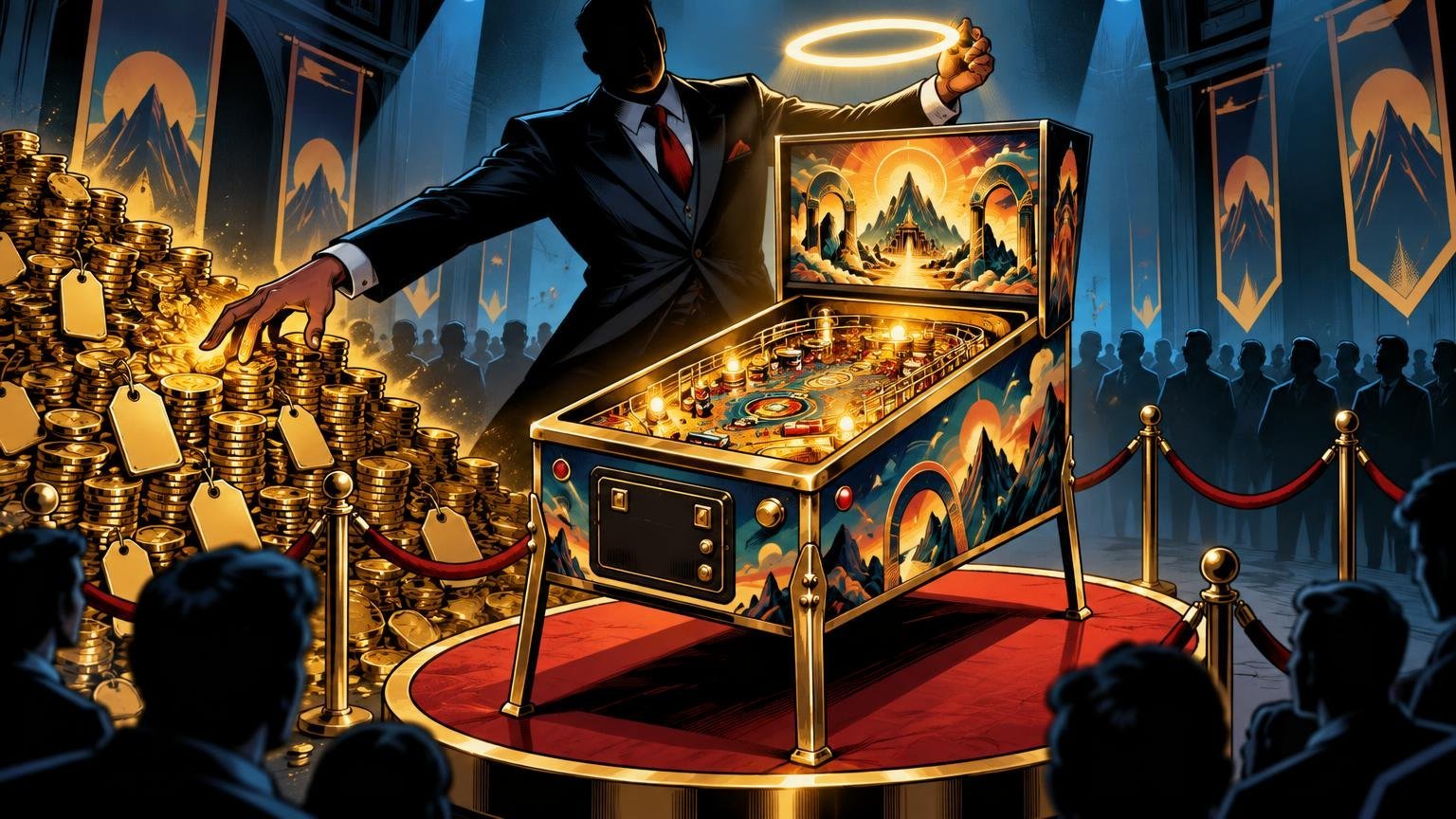
The Goonies SLE was engineered to trigger collector desire: a tiny 85-machine run, cosmetic exclusivity and only 30 upgrade opportunities at the reported drawing price. Flip N Out did not create that entire structure, but it chose how to use its allocation. Its method intensified the same scarcity and FOMO that made the machine valuable, then presented the result as service to the community.
Zach Meny and Flip N Out were entitled to test the market. The community is entitled to remember how they did it. An asking price is not a completed sale, and the gap between offers is not proven dealer profit. None of those qualifications rescues the rhetoric.
The final judgment is simple: chase the windfall if that is the business decision, but spare everyone the request for a halo. A seller can hunt for the biggest wallet in the room, or it can build a reputation around equitable access. Trying to collect a scalper’s payday and a community hero’s applause at the same time is not balance. It is branding.