How Much Room Do You Need for a Pinball Machine at Home?

TLDR

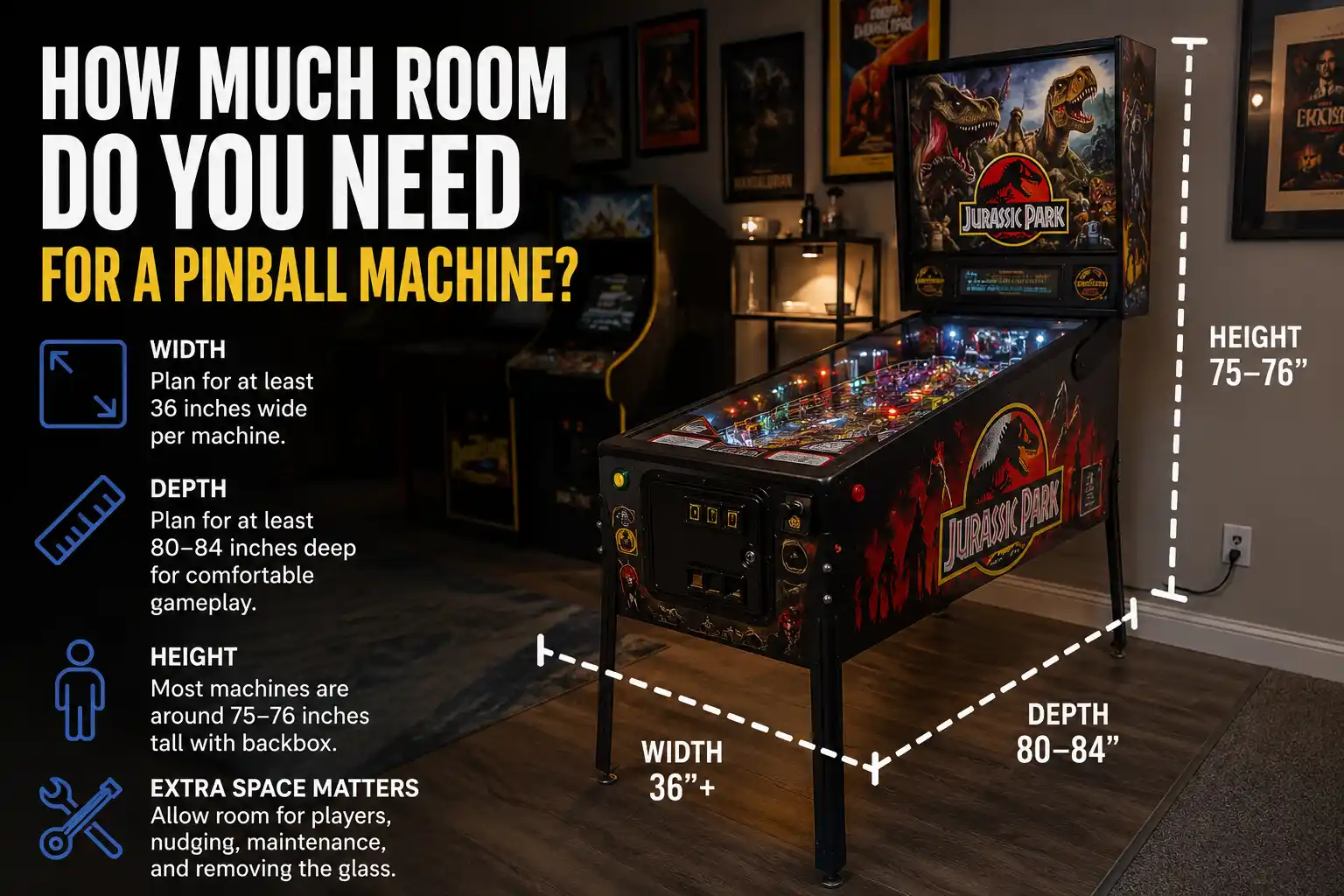
  • A full-size pinball machine usually needs about 3 feet wide by 7 feet deep of usable room to feel comfortable.
  • The machine itself is usually around 27 to 29 inches wide, 55 inches deep, and 75 to 76 inches tall when set up.
  • The extra space matters more than the cabinet size. You need room for the player, nudging, glass removal, service access, and people walking behind the game.
  • For one machine, plan on a practical footprint of 36 inches wide by 80 to 84 inches deep.
  • For two machines side by side, plan on at least 6 feet of wall width, and more if you want the row to feel comfortable.
  • Measure doorways, stair turns, ceiling height, and the final play area before buying or renting.

The short answer is that a real pinball machine does not need a massive room, but it does need more space than its cabinet dimensions suggest. If you are asking how much room do you need for a pinball machine, the safe home answer is simple: plan for about 3 feet of width and 7 feet of depth per machine.

That gives the game enough room to sit, enough room for the player to stand naturally, and enough clearance for the machine to be serviced without turning every minor adjustment into a furniture-moving project.

Why The Cabinet Measurement Is Not Enough

A pinball machine looks narrow from the front. That is the trap.

Most modern full-size machines are only a little over two feet wide. On paper, that sounds easy. You might look at a basement wall, office corner, spare bedroom, garage, or theater room and think, “That will fit.”

Maybe it will.

But pinball is not like sliding a bookcase into a corner. A machine has to be played, nudged, opened, leveled, cleaned, repaired, and occasionally moved. It has a backbox. It has a lockdown bar. It has legs that need space. It has a glass sheet that slides out the front. It has a coin door, buttons, side rails, power cord, and sometimes wall-sensitive topper or backbox clearance.

The machine’s listed dimensions tell you whether the object fits.

They do not tell you whether the room works.

That is the difference this guide is really about.

The Practical Home Footprint For One Pinball Machine

For one full-size pinball machine, use this planning rule:

Minimum workable space: 36 inches wide by 80 inches deep

Comfortable space: 42 inches wide by 84 inches deep

Ideal space: 48 inches wide by 90 inches deep

The machine itself may only be around 27 to 29 inches wide, but giving it at least 36 inches of width makes the room easier to use. That extra side clearance helps with nudging, cleaning, leveling, and avoiding scratches against walls or other machines.

Depth is even more important. A typical machine cabinet may be around 55 inches deep, but the player needs space behind the lockdown bar. If the game is crammed into a 60-inch-deep nook, technically it may fit, but nobody will enjoy playing it.

A realistic setup needs space for:

  • the full cabinet depth
  • the player’s stance
  • small body movement while playing
  • people passing behind the player
  • opening the coin door
  • sliding out the playfield glass
  • pulling the machine forward when needed

That is why about 7 feet of room depth is the number that keeps coming up in real home setups.

How Much Room Do You Need For A Pinball Machine If It Is Against A Wall?

If the machine is going against a wall, plan for a little breathing room behind it.

You do not need a giant gap. Pinball machines are designed to sit near walls in arcades and game rooms. But you also do not want the backbox jammed hard against drywall, trim, curtains, shelves, or acoustic panels.

A good home setup leaves enough space to:

  • avoid scraping the wall
  • route the power cord safely
  • reduce backbox vibration against the wall
  • allow tiny leveling adjustments
  • pull the machine forward if something needs attention

For most home rooms, leaving 2 to 4 inches behind the machine is enough. If you have a topper, wall shelf, low ceiling, mounted TV, framed poster, or slanted ceiling, measure more carefully.

The danger is not usually the machine body. The danger is the upper area around the backbox, topper, ceiling, and wall décor.

Do You Need Side Clearance?

Yes, but not always as much as people think.

A single machine can sit fairly close to a wall on one side. Many home owners do that. But if you are choosing the best spot in the room, leave a few inches of side clearance when possible.

Side clearance helps with:

  • nudging the machine without hitting a wall
  • opening the coin door comfortably
  • adjusting leg levelers
  • cleaning around the machine
  • protecting side art from scuffs
  • making the setup feel less cramped

If you only have one machine, try to leave 3 to 6 inches on each side if the room allows it.

If you are placing machines side by side, the spacing can be tighter. In a dedicated pinball row, machines often sit close together. Still, leaving a little space between cabinets makes the row easier to live with. It also reduces the chance of side art damage when someone moves, cleans, or services a game.

How Much Space Do You Need For Two Pinball Machines?

For two full-size pinball machines side by side, the absolute machine width may be only about 54 to 58 inches total. But a comfortable home row needs more than that.

Use this rule:

Tight two-machine setup: about 5.5 feet wide

Comfortable two-machine setup: about 6 to 6.5 feet wide

Ideal two-machine setup: 7 feet wide or more

The wider number gives you breathing room between machines and side clearance at the ends. It also makes the row look intentional instead of wedged into a leftover wall.

Depth stays about the same as one machine. You still want roughly 7 feet of usable depth from the wall to the standing area.

A two-machine row works especially well in:

  • basements
  • bonus rooms
  • garages
  • theater rooms
  • office lounges
  • wide hall-style recreation rooms

It works less well in narrow rooms where the player blocks the entire walkway. A pinball machine can technically fit in a hallway-style room, but if every game forces people to squeeze past the player, the room will feel annoying fast.

How Much Space Do You Need For Three Or More Pinball Machines?

Once you get to three machines, think in terms of a real row.

For three full-size machines, plan for at least 9 feet of wall width if you want the setup to feel comfortable. You may be able to do it tighter, but 9 feet gives you a much better result.

For four machines, plan for roughly 12 feet or more.

For five machines, plan for roughly 15 feet or more.

These are not hard engineering numbers. They are practical room-planning numbers. They assume a full-size game, some side clearance, and a room that still feels usable.

The bigger issue becomes the player zone. Three people can stand at three machines at once. Four people can gather behind them. Suddenly your “pinball wall” is not just furniture. It is a social area.

That means you should also think about:

  • where people stand while waiting
  • whether players block a door
  • whether the row faces a couch or TV
  • whether the room gets too loud
  • whether the floor can handle constant traffic
  • whether the machines have enough power outlets

A single pinball machine is a piece of entertainment equipment.

A row of pinball machines is a room plan. Read.

Doorways Matter More Than The Final Room

Before asking whether the room is big enough, ask a more annoying question:

Can the machine actually get there?

A pinball machine may fit beautifully in your basement once assembled, but that does not mean it can make it through the path to the basement. Delivery problems usually happen before the machine reaches its final wall.

Measure:

  • front door width
  • interior door width
  • hallway width
  • stair width
  • stair landing depth
  • tight turns
  • basement door clearance
  • elevator size, if relevant
  • garage entry
  • ceiling height on stair turns

This is where people get surprised. The final room may be fine, but the turn at the bottom of the stairs may not be. Or the doorway may be wide enough, but the hallway immediately after it may not allow the machine to rotate.

A pinball machine can be moved with the legs removed and backbox folded or removed, but it is still large, heavy, and awkward. The moving path matters.

If you are renting, ask the rental company what measurements they need before delivery. If you are buying, ask the seller how the machine will be transported and whether they expect the backbox, legs, or head to be removed.

Ceiling Height Usually Works, But Check Anyway

Most normal rooms have enough ceiling height for a modern full-size pinball machine. A standard 8-foot ceiling is usually fine.

The places to check are:

  • basements with low ceilings
  • rooms with exposed ductwork
  • rooms with drop ceilings
  • sloped bonus rooms
  • garages with overhead storage
  • game rooms with mounted shelves
  • topper installations

The machine itself may stand around 75 to 76 inches tall, but toppers can add more height. Some toppers are subtle. Others change the clearance question completely.

If you are buying a specific game with a topper, measure the topper height separately. Do not assume the listed cabinet height includes everything you plan to display.

Can A Pinball Machine Go In A Bedroom?

Yes, but a bedroom is rarely the best pinball room unless it is being used as a dedicated game room.

The machine can physically fit in many bedrooms. The real questions are sound, walking space, floor layout, and whether the game dominates the room.

A bedroom pinball setup works best when:

  • the room is a spare room
  • the bed is gone or small
  • there is a dedicated wall
  • the door swing does not conflict with the machine
  • the player has room behind the game
  • the machine will not bother sleepers nearby

Pinball is loud. Even with the volume down, the mechanical sound of flippers, ball hits, targets, knocker effects, and cabinet vibration is part of the experience. A bedroom next to a nursery, shared wall, or quiet office may not be ideal.

If the bedroom is really a bonus game room, it can work great. If it still needs to function like a normal bedroom, the machine may feel too dominant.

Can A Pinball Machine Go In A Garage?

A garage can be a good pinball space, but only if the environment is controlled enough.

The space is often great. Garages have wide doors, concrete floors, and room for a row. The concerns are temperature, humidity, dust, sunlight, pests, and whether the garage is actually pleasant to use.

A garage setup works better when:

  • the garage is insulated
  • temperature swings are moderate
  • humidity is controlled
  • the machine is not in direct sunlight
  • the floor is clean and level
  • the game is protected from cars, tools, and storage clutter
  • power access is safe and practical

A pinball machine is a large electronic and mechanical object. It does not love dampness, dust, or extreme heat. If the garage feels like a finished room, great. If it feels like a shed with a roll-up door, think carefully before putting an expensive machine there long term.

Can A Pinball Machine Go Upstairs?

Yes, but moving it upstairs is the hard part.

The floor in a normal home is usually not the first concern for one machine. A full-size pinball machine often weighs somewhere in the same general range as a heavy appliance, large treadmill, or substantial piece of furniture. The bigger issue is moving and access.

Stairs introduce risk:

  • tight turns
  • low overhead clearance
  • narrow landings
  • handrails
  • wall damage
  • machine damage
  • mover safety

If the machine needs to go upstairs or downstairs, it is worth using experienced pinball movers or a rental company that handles delivery. This is especially true if the machine is valuable, older, widebody, or going through a difficult path.

You do not want your first pinball memory to be three friends trapped on a staircase with a 275-pound cabinet.

The Player Zone: The Most Forgotten Measurement

When people measure for pinball, they often measure the machine.

Then they forget the player.

That is the mistake.

The player needs room to stand naturally, shift weight, nudge, step back, and let someone else take a turn. A pinball player does not stand perfectly still like someone reading a sign. Even a casual player moves a little.

Plan for at least 24 inches of player space behind the front of the machine.

More is better.

For a comfortable home arcade, 30 to 36 inches behind the machine feels much better, especially if people are watching or walking past.

This is why a 55-inch-deep machine becomes a 80-inch or 84-inch room-depth requirement in practice. The cabinet is not the whole footprint. The player is part of the footprint.

Leave Room To Remove The Glass

This is another detail beginners miss.

Pinball machines are serviced from the top. To clean the playfield, remove balls, fix simple issues, or access parts, the front lockdown bar comes off and the glass slides out toward the player.

That means you need room in front of the machine.

If your machine is jammed too close to a couch, desk, wall, bar, or another arcade cabinet, removing the glass becomes a hassle. You may have to move furniture just to do basic maintenance.

That gets old quickly.

A good setup leaves enough front clearance that you can:

  • remove the lockdown bar
  • slide out the glass
  • place the glass somewhere safe
  • lift or access the playfield
  • reach the coin door
  • work without bumping into furniture

This does not mean you need an empty room. It just means the space in front of the machine should not be blocked by heavy furniture.

Noise Clearance Matters Too

Pinball is not just visual. It is physical and loud.

A machine makes sound from:

  • speakers
  • flippers
  • pop bumpers
  • slingshots
  • metal ramps
  • ball drops
  • knockers or shaker motors
  • cabinet vibration
  • people reacting to the game

That is part of the charm. It is also part of the room plan.

A pinball machine near a bedroom, shared wall, office, or TV area can become a conflict. If the machine is in a basement, garage, or dedicated game room, noise is usually easier to manage. If it is in a main living room, it may change how the whole area feels.

A good pinball space is not only big enough.

It is also a place where the sound makes sense.

Power And Outlet Placement

Most home pinball setups do not need complicated electrical planning for a single game. You generally need a standard outlet and a safe way to route the cord.

But you should avoid messy extension-cord setups when possible.

Before placing the machine, check:

  • where the nearest outlet is
  • whether the cord crosses a walkway
  • whether a surge protector is needed
  • whether multiple machines will share a circuit
  • whether the outlet is behind the machine or off to the side
  • whether the plug will be crushed against the wall

For one machine, this is usually easy. For a row of machines, plan power before the machines arrive. It is much easier to solve outlet placement before several heavy cabinets are lined up against the wall.

The Best Rooms For A Home Pinball Machine

The best pinball rooms have three qualities: space, tolerance for noise, and easy access.

Strong options include:

  • basement game rooms
  • bonus rooms
  • finished garages
  • theater rooms
  • office lounges
  • large spare bedrooms
  • dedicated arcade rooms
  • open recreation rooms

Weaker options include:

  • narrow hallways
  • formal living rooms with fragile furniture
  • bedrooms used for sleeping
  • upstairs rooms with tight stair access
  • damp garages
  • rooms with low ceilings or awkward sloped walls

The machine can fit in more places than you might think. But the best spot is the one where people will actually play it without feeling like the room is fighting them.

A Quick Planning Rule Before You Buy Or Rent

Use this simple test before committing:

The 3-by-7 Rule

For every full-size pinball machine, assume you need:

  • 3 feet of width
  • 7 feet of depth
  • about 7 feet of clear height
  • a safe delivery path
  • a nearby outlet
  • room to remove the glass
  • enough sound tolerance for real play

If your room passes that test, a pinball machine is realistic.

If the room barely passes, it may still work, but you should think carefully about comfort, service, and player movement.

If the room fails the test, renting a machine first may be smarter than buying one. A rental can tell you whether the space works before you commit to ownership.

How To Measure Your Room

Here is the easiest way to check your space.

First, measure the wall where the machine will go. You want at least 36 inches of usable width for one machine, and more if possible.

Second, measure from the wall into the room. You want at least 80 inches, and ideally closer to 84 or 90 inches.

Third, stand where the player would stand. Make sure a person can play without blocking a door, walkway, couch, desk, or TV path.

Fourth, check ceiling height around the backbox area. If there is a shelf, duct, beam, sloped ceiling, or topper, measure twice.

Fifth, walk the delivery path from the outside door to the final spot. Look for narrow doorways, stair turns, low ceilings, tight corners, and fragile flooring.

Sixth, check the outlet. Make sure the cord path is safe and clean.

If all six checks work, the room is probably pinball-ready.

What If You Are Renting Instead Of Buying?

Renting makes the space question easier because you are not making a permanent commitment. It also makes the space question more important because delivery day is closer.

Before renting, ask the company:

  • What are the machine’s setup dimensions?
  • How much space do they recommend around it?
  • Do they need photos of the delivery path?
  • Can they handle stairs?
  • Is there an extra fee for difficult access?
  • Who levels the machine?
  • Who handles service if something goes wrong?
  • Can they recommend a different title if the space is tight?

A good rental company should care about the room. Pinball plays differently when a machine is not level, when the floor is unstable, or when players are squeezed into a bad spot.

The right machine in the wrong room can feel worse than a simpler machine in a comfortable one.

Final Answer: How Much Room Do You Need For A Pinball Machine?

For most homes, you should plan on at least 3 feet wide by 7 feet deep for one full-size pinball machine.

That is the practical answer.

The machine itself is smaller than that, but the experience is not. You need room for the cabinet, the player, nudging, maintenance, glass removal, safe access, and enough breathing room that the game feels like part of the room instead of a problem you squeezed into it.

If you are planning one machine, measure for a 36-inch by 80-to-84-inch footprint.

If you are planning a row, give each machine about 3 feet of wall width and keep the same 7-foot depth rule.

If you have the space, a real pinball machine can be one of the best home arcade additions you can make. It is social, loud, tactile, replayable, and far more interesting than another screen in the corner.

Just measure first.

The fun part starts after the machine actually fits.

FAQs

Can A Pinball Machine Fit Through A Standard Door?

Usually, yes, but it depends on the machine, the doorway, and how the machine is prepared for moving. Legs are typically removed, and the backbox may be folded or removed. Measure the full path, not just the final doorway.

How Much Space Should I Leave Behind A Pinball Machine?

Leave at least a few inches behind the machine when possible. You need room for the power cord, small adjustments, wall protection, and backbox clearance. If there is a topper, shelf, or low ceiling, measure more carefully.

How Much Space Should I Leave Between Pinball Machines?

For a tight row, machines can sit fairly close together. For a more comfortable home setup, leave a few inches between cabinets. That helps protect side art and makes cleaning or servicing easier.

Can I Put A Pinball Machine On Carpet?

Yes, but leveling can be more annoying on thick carpet. The machine may settle over time, especially if the carpet and pad are soft. A hard, level floor is easier, but carpet is not automatically a deal-breaker.

Is A Pinball Machine Too Heavy For A House?

One machine is usually manageable in a normal home when placed sensibly, but moving it is the real challenge. Stairs, tight turns, and awkward landings are usually more concerning than the final floor location.

What Is The Best Room For A Pinball Machine?

A basement, bonus room, finished garage, theater room, office lounge, or dedicated game room usually works best. The ideal room has enough space, a safe delivery path, good power access, and tolerance for noise.


Social Media

Most Popular

Get The Latest Updates

Subscribe To Our Weekly Newsletter

No spam, notifications only about new products, updates.
On Key

Related Posts

LG Put a Microphone in Your Living Room. Its Terms Make You Responsible for Everyone It Hears.

TLDR There is a microphone in the television. According to LG’s own service terms, certain voice-recognition features may capture and analyze the voices of family members, guests, children, and bystanders nearby. LG’s answer to the obvious privacy problem is blunt: obtaining the necessary consent is the owner’s responsibility. The wording reviewed for this article appears in current regional LG service terms. It says customers must notify household members and guests that their voices may be captured and processed in compliance with wiretapping, eavesdropping, and privacy laws. If someone does not consent, LG tells the owner to disable the microphone or voice features. LG then disclaims liability for the owner’s failure to obtain that consent or provide the warning. That is an extraordinary obligation to place on someone who bought a television. LG developed the product. LG included the voice-recognition system. LG operates or enables the AI-based services. But when another person’s voice enters the system, LG’s terms attempt to make the customer responsible for understanding the law and managing everyone else’s consent. LG supplies the listening technology. The owner gets the compliance problem. What LG’s Voice-Recognition Terms Actually Say The most alarming part of LG’s terms is not a vague statement that voice data may be processed. It is the list of people who may be affected. LG says third-party voices and utterances in the vicinity may be recorded and analyzed to provide AI-based services. The examples include: These are not all people who intentionally activated the voice assistant. A guest may not know the television has voice-recognition features. A child may not understand what audio processing means. A contractor, babysitter, cleaner, neighbor, or friend may have no reason to expect that speaking in the room could involve an LG service. LG’s terms then state that it is the user’s “sole responsibility” to obtain all necessary third-party consents and notify household members and guests. The company specifically mentions wiretapping, eavesdropping, and privacy laws. The terms do not give an ordinary customer a realistic system for doing any of this. There is no suggested notice to place on the door. There is no guest-consent screen. There is no household privacy dashboard explaining whose consent is needed in each jurisdiction. LG simply assigns the responsibility to the owner and advises turning off the microphone when someone objects. LG Says It Does Not Record Ambient Conversations It is important not to turn LG’s disturbing legal language into a claim the evidence does not support. LG has said its televisions do not collect, record, or store ambient conversations. The company says voice recognition is optional, user-initiated, and processes voice data only when activated to fulfill a request. It also says customers can use smart TV features without enabling voice recognition. LG’s US support instructions also show that voice recognition can be enabled or adjusted through the television’s AI Service settings. Some models support wake-word and hands-free controls, while available features vary by model and webOS generation. Those facts matter. The terms do not prove that every LG television continuously records every conversation in the room. They do not prove that LG is intentionally violating wiretapping law. They also may not apply identically in every country, since LG publishes different terms and services across regions. But LG’s response does not make the terms harmless. The company’s own agreement still recognizes that third-party voices may be captured during use of voice-recognition features. It still names children, guests, and bystanders. And it still attempts to make the customer responsible for consent, notification, and legal compliance. The concern is narrower than “LG listens to everything.” It is also more defensible: LG created a voice-processing system that may capture people who never bought the television, never opened an LG account, and never accepted LG’s terms. Your Guests Never Agreed to LG’s Terms A customer may click “agree” during television setup. That does not mean everyone entering the customer’s home has also agreed. Consider a normal living room during a football game. Friends are talking over the television. Children are playing nearby. Someone uses a voice command to search for a player or change the volume. Another person’s words are picked up at the same time. Who gave consent? LG’s terms appear to say that answering that question is the owner’s job. The same problem exists in less obvious settings. LG televisions may be found in hotel rooms, rental properties, conference rooms, waiting areas, restaurants, classrooms, offices, and shared homes. The person who agreed to the service terms may not even be present when someone else’s voice is captured. A contract between LG and the device owner cannot automatically create informed consent from every third party near the product. That does not mean voice capture is always illegal. Recording and privacy laws vary by country and state. Some laws focus on whether a person reasonably expected privacy. Others distinguish between recording a conversation and processing a voice command. The details matter. But those details are exactly why LG’s “sole responsibility” language is so unreasonable for an ordinary buyer. The average television owner should not need to research state recording statutes before asking the television to open Netflix. What Does LG Expect Owners to Tell Visitors? Taken literally, LG’s terms create a social ritual that almost no one will follow. A homeowner would need to say something like: Before we watch the game, you should know that this LG television has voice-recognition features. Your voice may be captured and processed when those features are used. Please tell me if you do not consent so I can disable the microphone. That might satisfy the spirit of LG’s warning. It would also be absurd in a normal home. Should parents obtain permission before their children bring friends into the room? Should someone warn a plumber before demonstrating a noise coming from the television? Should a short-term rental owner place an audio-processing disclosure beside the remote? LG’s terms give customers the obligation without giving them a usable process. And when consent is not

Fixing MTG Arena Friends List Not Working

The MTG Arena friends list may stop working for a few common reasons: friend requests fail, a display name or five-digit number does not match exactly, Direct Challenge or Challenge Lobby screens get stuck, the social panel shows outdated information, or Arena is dealing with a server-side issue. If you are trying to add friends, receive requests, or start a match and nothing behaves the way it should, the usual fixes are checking the exact account name and number, restarting the client, updating the game, and making sure your network connection is stable. The MTG Arena friends list is supposed to make playing with friends simple: add a player, send a challenge, pick decks, and start the match. When it works, great. When it does not, you get the full Arena social experience: missing friend requests, stuck challenge screens, mismatched names, and two players staring at menus while insisting they definitely typed everything correctly. Most MTG Arena friends list problems fall into a few buckets. The friend request will not send. The friend does not appear. The display name or five-digit number is wrong. Direct Challenge or Challenge Lobby invites get stuck. The social panel shows outdated information. Or the entire friends list behaves like it has been hit by a very legal, very annoying bounce spell. Wizards has also acknowledged multiple social and challenge-related issues over time, including Direct Challenge mismatched-option behavior, friend requests lingering after acceptance, challenge animations looping, and friend challenge UI problems. So if you are having trouble, it is not always user error. Sometimes the client is simply doing Arena things. This guide focuses on the fixes that matter most to players dealing with friends list and challenge problems, from basic checks and cache clearing to advanced network troubleshooting, bug reporting with logs, and a few habits that help keep the feature working reliably. https://magic.wizards.com/en/mtgarena Gathering Arena Friends List Context The friends list in MTG Arena is tied to your Wizards account display name, your five-digit identifier, the client’s social menu, and the current challenge system. Older guides and many players still say “Direct Challenge,” while newer Arena updates introduced Challenge Lobbies, which unified Friend Challenge and Direct Challenge into one lobby-style system. Wizards announced Challenge Lobbies as a social feature upgrade that lets players create lobbies from the Challenges section of the social menu or invite online friends from the friends list. That matters because some troubleshooting depends on which flow you are using. A friend request issue is different from a challenge issue. A display name problem is different from a server-side social outage. And a challenge that will not start may have nothing to do with your friends list at all. Start with the simplest explanation first. Check spelling, restart the client, confirm the game is updated, then move into cache, reinstall, logs, and support. Quick Checks For MTG Arena Friend List Before deleting files or reinstalling anything, run through the basic fixes. They are boring, yes. They also solve a surprising number of Arena problems, which is somehow both comforting and irritating. First, restart MTG Arena completely. Do not just return to the home screen. Close the client, wait a few seconds, and relaunch it. On mobile, force close the app and reopen it. Next, check the official MTG Arena status page. The status page tracks platform and service components such as Windows, macOS, Android, iOS, Game, Logins, Matches, Social, and Store. If Social, Logins, or Matches are degraded, your friends list may not behave normally no matter what you do locally. Then update the game. If Arena is asking for a small download or restart after a patch, both players should update before trying to add friends or challenge each other. Wizards notes that update and install problems can come from network issues, Windows-level problems, or leftovers from a partial install. Finally, confirm your network is stable. If Arena loads slowly, hangs on menus, or disconnects often, the friends list may only be a symptom. On mobile, Wizards recommends checking the device’s internet connection, toggling Wi-Fi off and on, restarting the device, force closing background apps, updating the app, and reinstalling if needed. Troubleshoot: Add Friends And Display Name Issues Most failed friend requests come down to the display name. Friends list issues in MTG Arena are common because Arena is strict about username formatting. MTG Arena names are not just “PlayerName.” They include the visible display name plus a five-digit number, usually shown in the format DisplayName#12345. Wizards’ Direct Challenge FAQ says players need both the display name and the five-digit number associated with the account. It also notes that display names are case sensitive, which means DragonFan#12345 and dragonfan#12345 may not be treated the same. Check these details before assuming the friends list is broken: Make sure the display name is typed exactly as shown. Confirm capitalization. Confirm the five-digit number separately. Do not include extra spaces before or after the name. Make sure your friend is sending you the correct account name, not the name from an old or secondary account. That last point matters. Wizards explains that two accounts can have the same display name text but different five-digit identifiers, such as SameDisplayName#12345 and SameDisplayName#54321. If a player accidentally logs into or creates a secondary account, the friends list lookup will not point to the account they actually use. The safest method is to have your friend copy their full Arena name from the client and send it to you outside the game. If they type it manually, ask for a screenshot. It feels overly cautious until you lose ten minutes to one lowercase letter. Step-by-Step: Add Friends To add a friend in MTG Arena, use the friends list panel rather than guessing from the main Play menu. Open the Friends List panel, usually found at the bottom-left of the Arena client. Click the plus sign at the top right of the friends list. Enter the exact Arena username for the person you want to

Cheap MTG Cards: Budget Options for Magic Collections

Cheap MTG Cards are not just for new players. They are for Commander brewers, cube builders, collectors who like having options, and anyone who has ever looked at the price of one land and thought, “Surely cardboard has gone too far.” The best budget strategy is not one single source. It is a mix. Use real singles when you need tournament legality, use lots when you want volume, use proxies for casual testing, and use ready-made cube products when you want a complete play experience without turning your evenings into spreadsheet maintenance. Gathering Cards: Cheap MTG Cards Sources The cheapest MTG collection strategy usually breaks into four lanes. ProxyMTG.com is a strong choice for bulk budget proxies and on-demand printed proxy cards for casual use. Print-at-home proxies are the cheapest overall route if your group allows them and you already have a printer. PrintACube.com is worth considering if you want a ready-to-draft 540-card cube near the $100 mark. For authentic cards, compare singles against bulk lots before buying, because “cheap” can mean very different things depending on your goal. Singles are better when you need specific cards. Lots are better when you want maximum cardboard per dollar. Proxies are better when you want to test decks or protect expensive originals. Cubes are better when you want an entire repeatable format in one purchase. ProxyMTG.com And Bulk Proxies ProxyMTG.com is one of the better budget options for players who want bulk proxies and on-demand printing. The value improves as order size increases, which matters if you are printing a Commander deck, testing multiple decks, or building a cube. Before ordering from any proxy seller, check the reputation, production samples, card feel, customer photos, and shipping policies. Good proxy cards should be clearly treated as proxies, not as tournament-legal originals. They should also be readable, consistent in size, and easy to sleeve. Also check delivery times and shipping costs before buying. A low per-card price can get less exciting once shipping, tracking, taxes, and rush fees join the table like an uninvited combo player. Print At Home: Cheapest Route Printing proxies at home is usually the lowest per-card cost. It is not the prettiest option, but it works well for deck testing, kitchen-table Commander, cube prototypes, and deciding whether a card is actually good before spending money on the real version. For better durability, print on heavier cardstock or print on paper and sleeve the proxy in front of a bulk card. The sleeve and backing card do a lot of the work. You are not trying to create a museum object. You are trying to remember whether your seven-mana dragon is playable or just emotionally persuasive. Check local event rules before using printed proxies. Home-printed cards are fine for many casual groups, but sanctioned Magic events require authentic cards except for judge-issued proxies in narrow tournament situations. PrintACube.com Cheap Cube Option PrintACube.com is a useful shortcut for players who want a full cube without buying hundreds of individual singles. Its headline value is the ability to get a complete 540-card cube around $100, which is hard to beat if your goal is draft nights rather than collecting originals. This is especially attractive for cube beginners. Building a cube from scratch can be fun, but it also means choosing archetypes, balancing colors, sourcing cards, sleeving everything, and updating the list over time. Buying a ready cube skips a lot of that work. If your playgroup wants a repeatable draft experience and does not care whether every card is an authentic original, a ready-made proxy cube can be one of the most cost-efficient MTG purchases you make. Buying Singles Vs Lots Buy singles when you need exact cards. This is the right move for Commander staples, missing lands, sideboard cards, or format-specific pieces. Singles reduce waste because you are not buying 800 random cards to find three that matter. Buy lots when you want volume. Bulk lots are useful for new players, casual deckbuilding, school clubs, cube experiments, and anyone who wants a pile of commons and uncommons for cheap. Just understand that most lots are not secretly filled with expensive staples. Sellers also know how Google works. Compare per-card prices across multiple sellers. A $20 lot of 1,000 cards sounds great, but if shipping is $18 and the lot is mostly duplicate draft chaff, the value may be less impressive. On the other hand, a well-sorted lot with lands, tokens, commons, uncommons, and usable rares can be a great starter purchase. Local Sources And Community Local game stores are still one of the best places to find cheap MTG cards. Many stores have bulk boxes, discounted binders, damaged-card bins, and low-cost singles that are not worth listing online. Trade nights can be even better. Bring cards you do not use and trade into cards you actually need. For budget players, trading is often more effective than buying because you are converting dead collection value into playable cards. Also scan Facebook Marketplace, local classifieds, and community groups regularly. Collections appear when players move, quit, clean out closets, or decide that they have too many white storage boxes. Which, to be fair, is all of us eventually. MTG Cards: Quick Buying Tips Compare market prices across major trading sites before you buy. Do not rely on a single listing. One seller asking $12 for a $3 card does not make the card $12. It makes that seller optimistic. Check seller photos for condition accuracy, especially on older cards, foils, and higher-value staples. “Lightly played” can mean very different things depending on the seller’s eyesight and moral flexibility. Set alerts for price drops on targeted cards. Price trackers are useful for Commander staples, reprints, and cards that spike because of new set previews. If you can wait, waiting often saves money. Magic The Gathering Basics For Budget Buyers Rarity affects price, but it does not control price by itself. Commons and uncommons are usually cheaper because they are printed more frequently, while rares and

Where to Buy MTG Proxies: Best Sites, Pricing, And How To Order

TLDR The best place to buy MTG proxies depends on what you need. ProxyMTG.com is the best pick for deck-building tools and bulk pricing. PrintMTG.com is best for high-quality print on demand proxies with strong cardstock and service. ProxyKing.biz is best for single staples, dual lands, and realistic proxy cards. For print-at-home testing, use MTGprint. For cubes and large custom batches, consider ProxyPrintery or MakePlayingCards with MPCFill. Avoid PrintingProxies for bulk orders if price matters, since its published high-volume pricing is much higher than ProxyMTG and PrintMTG. Avoid Proxxied if you are trying to buy finished cards, because it is a browser-based print-at-home tool, not a finished-card seller. What This Guide Covers Buying MTG proxies can mean a few different things. Some players want a full Commander deck printed and shipped. Some want a few expensive staples for casual play. Some want a print-at-home PDF. Some want custom cards, double-sided cards, foil upgrades, or an entire cube. This guide is for players who want to know where to buy MTG proxies, what each site is best at, how pricing works, and how to place an order without creating a pile of unusable cards. The selection criteria are simple: print quality, cardstock fidelity, price per card, bulk-order value, ordering tools, decklist import support, turnaround, reputation, realistic appearance, and whether the site is better for casual play, playtesting, custom cards, or full-deck production. The short version: start with ProxyMTG.com, PrintMTG.com, or ProxyKing.biz if you want finished cards. Use MTGprint if you want print-at-home control. Use MPC if you are comfortable with a more involved workflow and want low per-card pricing on custom deck production. Why Choose MTG Proxies Players use MTG proxies for three main reasons: casual play, playtesting, and protecting expensive Magic cards. Casual play is the big one. Commander players often want to try a mana base, a few Reserved List cards, a cEDH shell, or a new deck idea without spending hundreds or thousands of dollars first. A proxy lets the group focus on the game instead of everyone’s collection value. Playtesting is another good use. If you are tuning a cube, testing a new Commander list, or trying cards before buying real copies, proxies save time and money. You can test ten versions of a card package before deciding which real cards are worth buying. Protection matters too. If you own expensive MTG cards, you may not want to shuffle them every week. ProxyKing describes proxies as stand-ins that let players avoid damaging high-value cards, especially expensive staples, dual lands, fetch lands, and other cards that can be costly to replace. Proxies are also useful for custom cards. Some players print custom commanders, cube cards, joke cards, tokens, alternate art versions, or entire deck projects. This is where services like PrintMTG, ProxyMTG, ProxyPrintery, MTGprint, and MPC start to feel very different from each other. How We Chose The Best MTG Proxies The first filter is print quality. A good proxy should be readable, centered well enough for sleeved play, and printed on cardstock that does not feel like paper in a sleeve. For higher-end orders, S33 German black-core stock is a common premium choice because it has a black-core center layer that blocks light and gives cards a more finished feel. The second filter is price. A few single cards can cost more per card and still make sense. A full Commander deck, cube update, or 500-card bulk order needs better pricing. ProxyMTG and PrintMTG both publish bulk pricing that drops as low as $0.30 per card at 1,000+ cards. The third filter is ordering friction. Decklist import matters. Searching card by card is fine for five cards. It is not fine for a full cube unless you enjoy turning admin work into a second hobby. The fourth filter is reputation and use case. Some sellers are best for realistic singles. Some are better for high-volume deck building. Some are better for home printing. And some are fine products but not the best value for the job. Best 6 Sites To Buy MTG Proxies For Deck Building 1. ProxyMTG ProxyMTG.com is the strongest first stop for players who want to print MTG proxies from a decklist, build large orders, and keep pricing clear. It is built around Commander, cube, casual play, and deck testing, with tools for browsing sets, searching cards, uploading lists, choosing versions, and checking out. Its main strength is bulk pricing. ProxyMTG lists a single card at $3, then $2 per card for 2–9 cards. Pricing drops as the order grows: $1.50 at 10–29 cards, $1.25 at 30–49, $1 at 50–74, $0.80 at 75–99, $0.55 at 100–199, $0.45 at 200–499, $0.35 at 500–999, and $0.30 at 1,000+ cards. That makes it especially good for full Commander decks, cube updates, and larger playtest batches. Ordering And Import Decks The cleanest ProxyMTG workflow is to upload a decklist or build a list inside the order tool. The site says users can browse the card library, choose versions, adjust quantities, and watch pricing update as the order grows. A typical order looks like this: ProxyMTG states that it prints on premium S33 German black-core cardstock with a UV coating, which is a good sign if you want cards that feel more like finished game pieces than paper inserts. Double-Sided MTG Proxies And Foil Options For double-sided cards, check the current order builder and ask support if the option is not obvious. ProxyMTG’s public customization guidelines mention custom backs and printed “holo stamp” style graphics when offered, but also clarifies that those are printed graphics, not physical foil stamps or authentication features. That distinction matters. If you need true foil upgrades or double-sided MTG proxies, confirm the option before placing a large order. Do not assume every proxy printer handles MDFCs, transform cards, custom backs, and foil effects the same way. Best for: full Commander decks, cube updates, large-volume deck building, and players who want strong pricing without building an MPC order themselves. Contact: ProxyMTG lists support@proxymtg.com as