TLDR
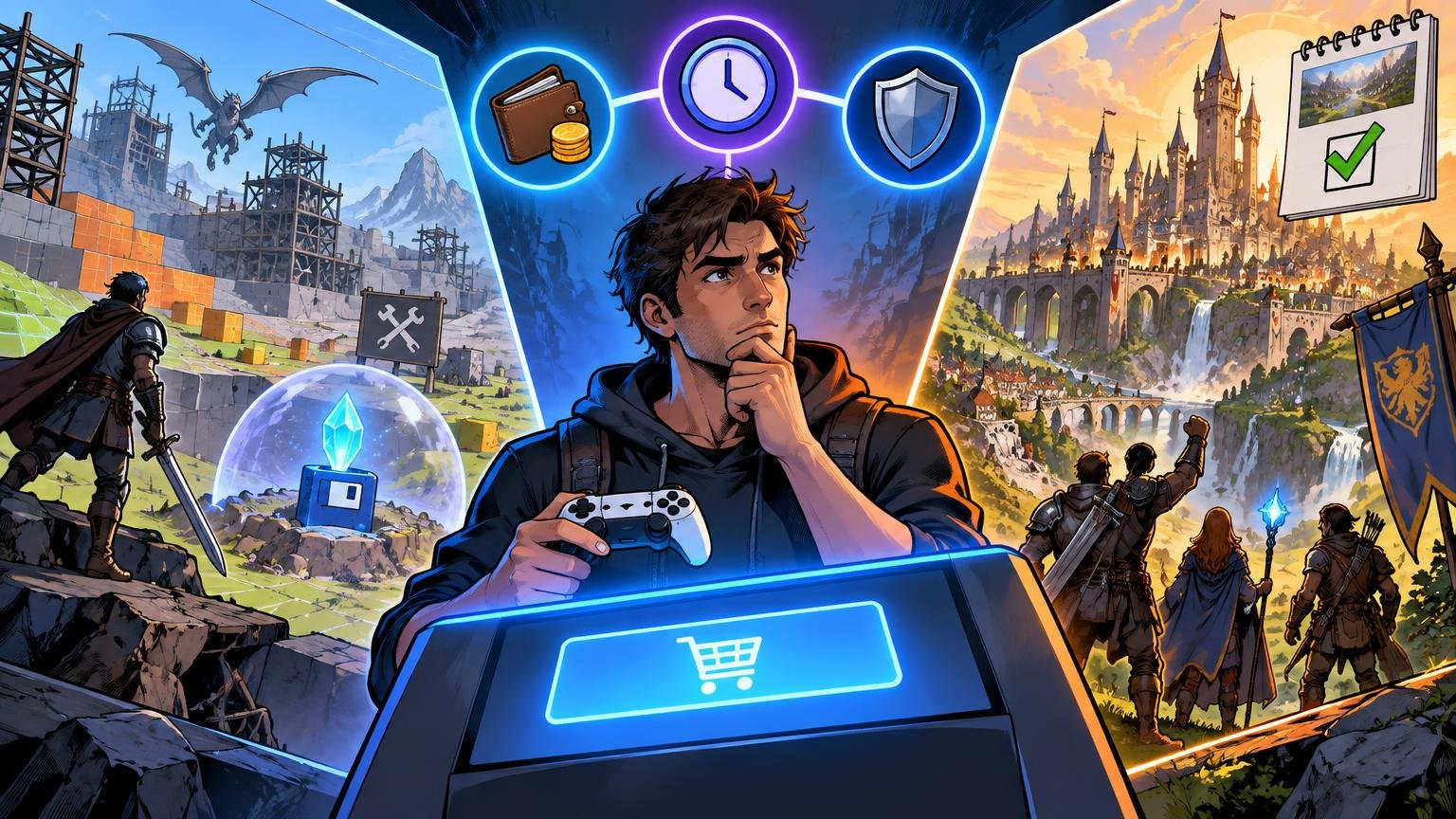
Game length vs value is not a simple equation. Price per hour can be a useful personal budgeting tool, especially when choosing between games you already expect to enjoy. It is a poor universal measure of quality, however, because it rewards repetition, grind, and filler just as readily as meaningful play. Judge value by total cost, the experience you want, content density, replayability, access conditions, and how well the game uses your limited time.
A 60-hour game is not automatically a better purchase than a focused eight-hour game. The longer title might deliver a world you happily inhabit for months, or it might stretch a thin set of ideas across repetitive objectives. The shorter game might feel insubstantial to one buyer and perfectly paced to another. Runtime tells you how much time a game may occupy. It does not tell you how rewarding that time will be.
Game length vs value asks two different questions
Discussions about runtime often combine two questions that should remain separate: “Is this game good?” and “Is this game a sensible purchase for me?” Quality concerns execution—design, controls, pacing, art, challenge, storytelling, and other features relevant to the genre. Purchase value concerns the relationship between those qualities and a particular player’s money, time, preferences, and access.
A tightly designed campaign can be excellent but still feel too expensive for a player with a strict entertainment budget. A sprawling role-playing game can provide abundant content but be a bad fit for someone who dislikes its combat loop or cannot accommodate a long campaign. Neither judgment needs to become a universal verdict.
Time does belong in criticism. A historical GameRevolution explanation described a “Good” review score as indicating that a game was “worth your time,” language that captures an important distinction: players spend attention as well as money. A game can be affordable and still demand more hours than a player wants to give it.
When dollars per hour is genuinely useful
Price per hour works best as a private filter rather than a public quality score. If you are comparing two games you want equally, expect to finish both, and know their likely total costs, the calculation can clarify how each option fits your budget.
For example, a hypothetical $60 game completed in 10 hours costs $6 per played hour. If repeated runs bring your total to 30 hours, that falls to $2 per hour. The arithmetic is valid, but its meaning depends on whether those additional runs are something you genuinely want. Leaving the game running, completing dull collectibles, or replaying content solely to improve the ratio does not create meaningful value.
Runtime estimates are particularly useful for practical planning. They can help you decide whether to start a campaign before a busy month, whether a cooperative group can realistically finish it, or whether an enormous open world suits your available free time. They can also expose a mismatch between a game’s price and the amount of content a particular buyer expects. These are legitimate uses because they treat length as context, not proof of quality.
Why the metric breaks down as a universal rule
Dollars per hour counts all hours equally. Players do not experience them equally. A memorable encounter, an emotionally effective scene, and an hour of repeated resource gathering all add the same number to the denominator. The formula therefore has no way to distinguish density from padding.
- Optional content distorts comparisons. One player may follow the main path while another clears every map marker.
- Genre expectations differ. A replayable strategy game, a competitive shooter, and a linear narrative adventure create value in fundamentally different ways.
- Difficulty and accessibility settings can change completion time without making one playthrough inherently more valuable.
- Repeated attempts may represent satisfying mastery or frustrating friction. Raw time cannot tell the difference.
- Opportunity cost matters. A 100-hour commitment may prevent a time-limited player from enjoying several shorter games.
- Unfinished games complicate the formula. A vast advertised runtime offers little practical value to someone who stops after five unrewarding hours.
The metric also creates a perverse incentive: any design that delays completion appears to improve value. Slow traversal, mandatory grinding, repeated missions, and stretched progression can all lower the calculated cost per hour. A useful buying standard should not automatically reward a game for taking longer to deliver the same amount of enjoyment.
Use a broader game-value checklist
A better judgment starts with the player’s intended experience. Consider these factors before treating a runtime estimate as decisive:
- Current total cost: Include the purchase price and any content or features you realistically expect to buy.
- Likely playtime: Estimate what you will play, not the maximum completionist total listed online.
- Content density: Ask whether missions, encounters, areas, and mechanics meaningfully develop or mostly repeat.
- Pacing: Consider whether the length supports the game’s ideas, story, and progression.
- Replayability: Count additional runs only if different builds, choices, modes, opponents, or mastery goals appeal to you.
- Personal preference: Ten hours in a favorite genre can offer more value than 80 hours in one you merely tolerate.
- Access conditions: Check whether play depends on a subscription, online servers, rotating catalog, or active player population.
- Exit quality: A game that remains satisfying without total completion may offer better practical value than one that withholds its payoff until the end.
This framework does not eliminate subjectivity; it makes the subjectivity honest. A buyer who loves speedrunning may assign substantial value to a short campaign with expressive mechanics. A story-focused player may value one carefully paced playthrough. Someone seeking a shared weekly activity may prioritize durable multiplayer systems instead.
Read playtime claims with their conditions attached
A playtime number is only meaningful when you know what it measures. “Twenty hours” could describe a rushed main path, a reviewer’s first run, a publisher estimate, or a run including substantial optional content. Before relying on it, look for the platform, difficulty, familiarity with the genre, side-content participation, use of guides, and whether dialogue or cutscenes were skipped.
Reviews should disclose these conditions when duration affects the verdict. The most useful wording is not simply “the game is 15 hours long,” but “the campaign took roughly 15 hours on a stated difficulty while completing a described amount of optional content.” That does not make the result universal, but it makes the estimate interpretable.
Completionist figures need particular care. Clearing every collectible or achievement may be rewarding to dedicated players, but it should not inflate the apparent value offered to an ordinary campaign player. Main-story time, substantial side-content time, and completionist time answer different buying questions.
Sticker price may not be the total cost
The dollars-per-hour calculation becomes even less reliable when the initial price does not capture the full business model. The Consumer Financial Protection Bureau’s video-game issue spotlight discusses models involving microtransactions and virtual currencies in addition to one-time purchases. This does not mean every game using ongoing purchases is poor value. It means buyers should calculate around the content and spending patterns that apply to them rather than pretending the box or storefront price settles the question.
Subscriptions add another complication. Access may be inexpensive while a title remains in a catalog, but the game competes with everything else covered by the same recurring fee. A player considering catalog access should compare the cost across the months actually required to finish, not assign the entire subscription price—or none of it—to one game. Our comparison of Xbox Game Pass and PlayStation Plus for casual players explores how play habits affect that broader subscription decision.
Early Access requires similar discipline. A long development roadmap is not playable value today. Buyers should judge the current build and treat future additions as uncertain upside, as explained in our Early Access buying guide. Server dependence, DLC plans, and the availability of offline modes can also change how long purchased content remains useful.
More hours do not automatically produce better outcomes
Research offers another reason to avoid treating logged time as a complete measure. A 2025 study covering 703 casually engaged adult Nintendo Switch players in the United States reported that raw playtime was not related to the well-being outcomes measured. Players’ assessments of how gaming fit into their lives were associated with those outcomes. The published study supports the narrower idea that the meaning and fit of play cannot be reduced to an hour count.
It does not prove that short games are healthier, that long games are worse, or that well-being determines purchase value. The sample, Nintendo-related activity data, and non-causal design limit what can responsibly be concluded. Its relevance here is conceptual: hours acquire significance through context, and different players can experience the same duration differently.
The better verdict: ask what the game does with its time
Game length should inform a purchase, not decide it. Use runtime to plan your schedule, set genre expectations, and compare options that already suit your interests. Use dollars per hour when it helps you stay within a personal budget. Do not turn either figure into a universal quality scale.
Before buying, identify the experience you want and the total amount you are prepared to spend. Then check whether the game’s main path, optional content, replay systems, monetization, and access conditions support that goal. A game offers good value when its cost and demands make sense for the enjoyment or meaning you expect—not merely when it keeps a timer running for longer.